The fastest way to find out whether ChatGPT recommends your brand: ask it the questions your customers ask — without naming yourself — and see if you show up. Below is a repeatable method, how to read what you get back, and what to fix when you’re invisible.
A quick caveat first: AI assistants are probabilistic, and many now fetch the live web for each query. The same question can return different answers on different runs. So this is a pattern-finding exercise, not a single pass/fail — test several phrasings and several runs, and look at the trend.
How to check, step by step
1. Write your buyer-intent prompts
List the questions a customer would actually ask an assistant — phrased by need, not by your brand or SKU. For example:
- “Best [product category] for [use case] under [budget]”
- “What [product] should I buy for [specific situation]?”
- “Recommend a [product] for [type of person]”
Aim for 10–15 prompts covering your main categories. These are the queries you actually need to win.
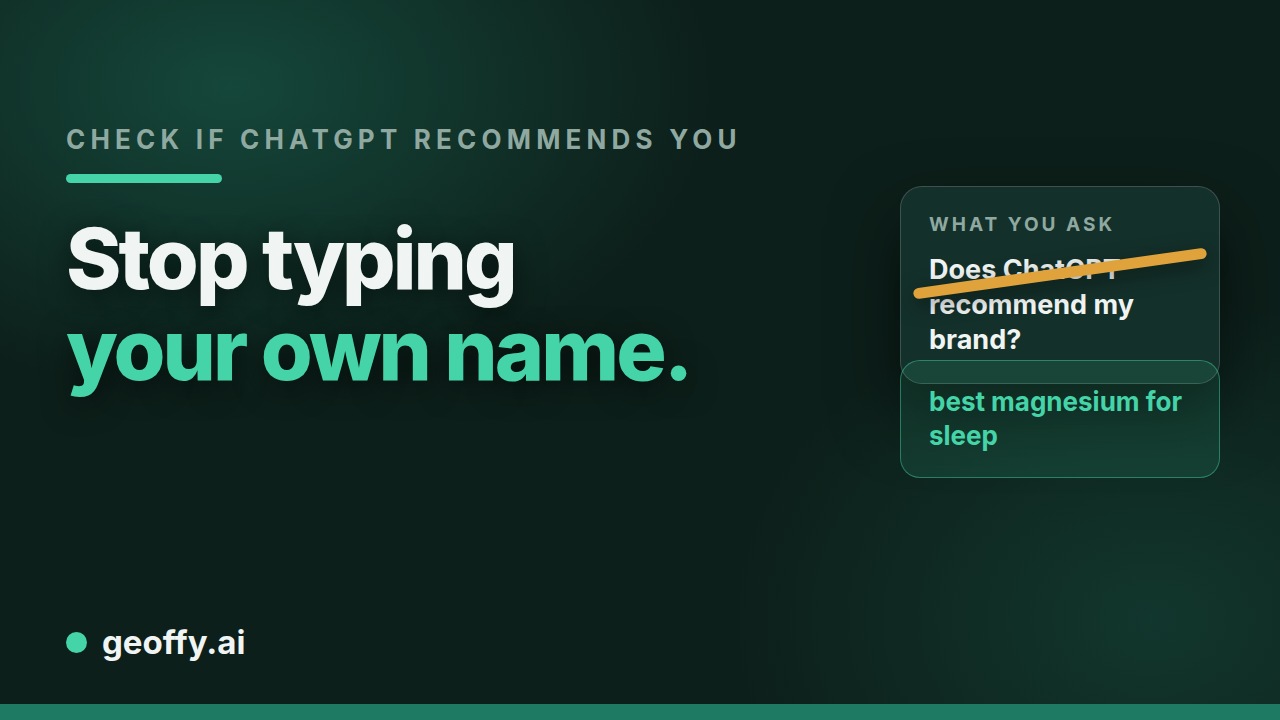
2. Ask without naming your brand
Open a fresh chat (no prior context that might bias the answer) and run each prompt. Don’t mention yourself — you want to see who the assistant recommends unprompted.
3. Record whether — and how — you appear
For each prompt, note one of three outcomes: recommended (named in the shortlist), mentioned (appears but not recommended), or absent. Also note who did get recommended — those are your real AI-discovery competitors.
4. Repeat across assistants and runs
Run the same prompts in ChatGPT, Gemini, Perplexity, and Claude, and run the key ones two or three times. Coverage varies a lot between assistants, and a single run can mislead.
5. Probe the gap
Where you’re absent, ask a follow-up: “What are the best options from [your brand]?” If the assistant can describe your products accurately, it knows you exist but didn’t rank you. If it’s vague or wrong, it can’t read your data well — a different, more fundamental problem.
How to read the results
- Recommended consistently: you’re AI-visible for that intent. Protect it and expand to adjacent queries.
- Mentioned but not recommended: the assistant knows you but doesn’t have enough signal to prefer you. Usually a structured-data and intent-page problem.
- Absent, but accurate on follow-up: discoverable but not competitive — strengthen attributes, use-case coverage, and corroborating sources.
- Absent and inaccurate on follow-up: the assistant can’t understand your catalogue. This is the foundational fix: crawlability and structured data first.
Why you’re not getting recommended
The common causes, roughly in order:
- Pages aren’t reliably crawlable by AI crawlers, so your data never enters the picture.
- Attributes aren’t structured — “premium quality” tells a model nothing it can match against intent.
- Pages that answer at only one depth — your product pages describe the SKU but never address the situation, constraint or comparison a shopper actually asks about.
- Stale or contradictory data — wrong prices or availability are strong negative signals and get sources excluded.
- Thin corroboration — few independent sources describe your products, so the model has low confidence.
These map directly onto how AI assistants choose which products to recommend and the groundwork in What is GEO.
What to do next
Fix the foundation in order: make pages crawlable, structure your product attributes and add schema, write the answer to the real intent question onto the product and category pages you already publish, and keep price and availability in sync. Then re-run the same prompt set and watch the pattern move.
If you’d rather not do the spot-check by hand every week, this is exactly what an AI-visibility tool automates — running a fixed prompt set across assistants on a schedule and tracking your share of recommendations over time. Geoffy both measures this and fixes the underlying data so the numbers move.
Frequently asked questions
How do I check if ChatGPT recommends my brand?
Ask ChatGPT the intent-based questions your customers actually use — for example “best magnesium supplement for sleep” — without naming your brand, and see whether your products appear. Repeat across several phrasings, a few assistants, and over time, because answers vary by run.
Why doesn’t ChatGPT recommend my products?
Usually because the assistant can’t find or can’t understand your product data: pages aren’t crawlable, attributes aren’t structured, the product page only answers at one depth of intent, or price and availability are stale or contradictory.
Why are the answers different each time I ask?
AI assistants are probabilistic and many now fetch the live web per query, so phrasing, timing, and the model version all change the result. Test multiple phrasings and runs and look at the pattern, not a single answer.
Can I track AI recommendations automatically?
Yes. Tools that run a fixed set of buyer-intent prompts across multiple assistants on a schedule turn this manual spot-check into a tracked visibility metric you can watch over time.
Sources
- Aggarwal et al. (2024), GEO: Generative Engine Optimization — https://arxiv.org/abs/2311.09735
- Cloudflare Radar 2025: AI crawler activity — https://blog.cloudflare.com/radar-2025-year-in-review
About the author
Anthony Gale is Co-Founder of Geoffy, a Generative Engine Optimisation platform for ecommerce brands. He has spent more than two decades in ecommerce and digital growth, helping retailers adapt to major shifts in online discovery.