Structure gets you into the game. Integrity keeps you there.
Updated July 2026. Two findings published since this paper strengthen its argument from different directions. Ahrefs’ controlled study (May 2026: 1,885 pages against 4,000 matched controls) found schema-only optimisation produced retrieval effects statistically indistinguishable from zero — structure without integrity moves nothing, exactly as argued below. And BrightEdge (May 2026) measured brand-owned commercial pages capturing 42–79% of consideration-stage citations across eight industries — the payoff side: when the owned page is coherent, it is the citation. Integrity remains the differentiator between the two results.
Abstract
Most GEO implementations are more fragile than they appear. Getting structured, answer-ready content and matching schema live on your canonical product pages is the first step — but without rigorous data integrity, the same implementation that improves visibility in the short term can degrade it over time. This paper examines why data integrity is the critical requirement for sustained AI recommendation inclusion.
Section 1: The problem with “generate and publish”
The most common GEO failure pattern we observe is this: a team structures its product pages and the schema behind them, publishes, and sees initial improvement. Then, over weeks and months, the catalogue changes — prices shift, products go out of stock, specifications are updated, variants are discontinued. The pages don’t keep up. What was accurate becomes stale. What was consistent becomes contradictory.
AI systems are sensitive to this. When the information they find about a product is internally inconsistent — when what’s stated in one place doesn’t match what’s visible in another — trust signals degrade. Recommendation inclusion follows.
Data integrity isn’t a nice-to-have quality measure. It’s the mechanism by which AI visibility is maintained over time.
Section 2: What integrity means in practice
At its core, data integrity for AI discovery means one thing: what AI systems read about a product must match what customers actually see.
This sounds simple. In practice, it requires deliberate systems. Product data changes constantly — and in most ecommerce catalogues, it changes faster than any manual content process can keep pace with. Prices change daily. Stock status shifts by the hour. Specifications are updated when suppliers change formulations. Variants are added and removed.
Each of these changes creates a potential gap between what’s declared and what’s true. And in AI recommendation systems, gaps create risk.
Section 3: The integrity requirements that matter most
From building and maintaining AI discovery infrastructure across ecommerce catalogues, three integrity requirements stand out as most consequential.
Attribute grounding. Every attribute that appears in a discovery context must be traceable to a verifiable source. Invented or inferred attributes — however plausible they seem — create a category of trust failure that compounds over time. If a system claims a product has a certain specification that doesn’t appear in the source catalogue data, and an AI assistant later encounters contradictory information, the damage isn’t just to that product — it extends to the domain’s overall credibility as a source.
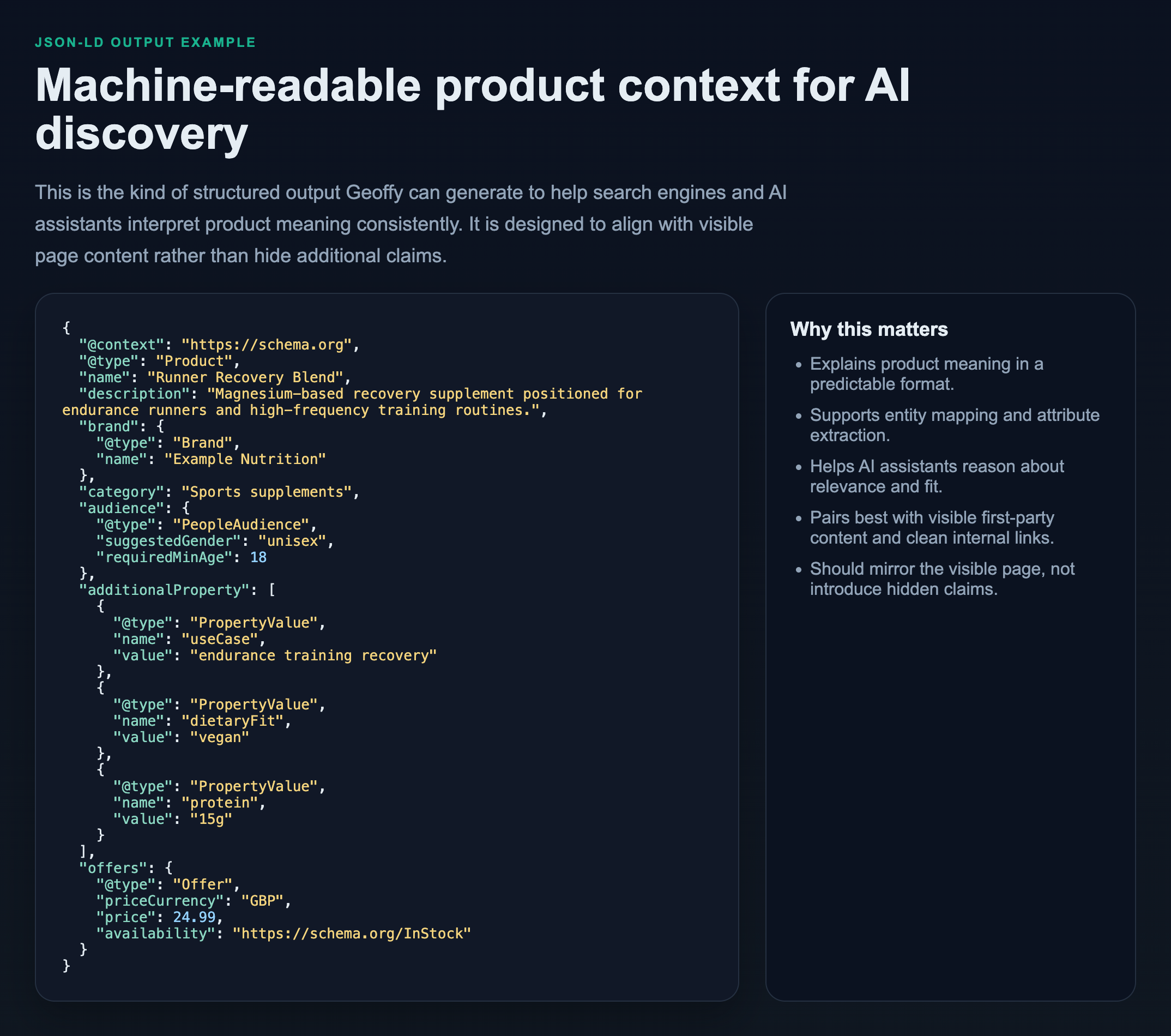
Parity between structured and visible content. AI systems increasingly cross-reference machine-readable signals against the human-readable content on the same page. Mismatches — structured data claiming something the visible page doesn’t confirm — are a reliability signal. They suggest either a technical error or deliberate manipulation, neither of which supports confident recommendation.
Drift management. Catalogues are live data systems. The content and structured data layered onto them must be treated the same way. Pages that were accurate at publication can become misleading within days as the underlying catalogue shifts. Without systematic monitoring and update processes, that layer has a natural decay curve. Integrity degrades silently, and visibility follows.
Section 4: Why this changes the evaluation of GEO tooling
When evaluating GEO approaches — whether that’s a platform, an agency implementation, or internal development — data integrity should be a primary evaluation criterion, not a secondary one.
The questions worth asking are straightforward: How does this approach ensure that attributes are grounded rather than generated? What happens when a product changes — how is discovery content kept current? Is there a mechanism to detect and resolve discrepancies between structured outputs and visible page content?
The answers to these questions predict long-term performance far better than the quality of initial implementation.
Section 5: The infrastructure-first principle
At Geoffy, we describe our approach as infrastructure-first rather than content-first. The distinction matters.
A content-first approach to GEO treats this as a content production exercise: write the copy, publish it, move on. An infrastructure-first approach treats the same content and its structured-data mirror as live data outputs — connected to source truth, validated before publication, and maintained as the underlying data changes.
The difference isn’t immediately visible in the outputs. A product page produced either way might look identical on day one. The difference becomes apparent over time, and particularly under the pressure of a live, changing catalogue.
Brands that build on infrastructure principles compound their AI visibility advantage. Brands that treat GEO as a content project tend to see initial gains followed by gradual erosion.
Conclusion
AI discovery is a live system, not a campaign. The ecommerce brands that will build durable recommendation visibility are the ones that treat their discovery infrastructure with the same rigour they apply to their product data: verified, maintained, and built to stay accurate as the underlying truth changes.
Structure is the entry requirement. Integrity is what keeps you in the game.
About Geoffy
Geoffy is a GEO platform built on infrastructure-first principles. The platform is designed to keep discovery outputs verified, current, and aligned with source product truth — across catalogues of any size, at any pace of change.
About the author
Branko Goricnik is CTO and Co-Founder of Geoffy. He has spent his career building data infrastructure and platform architecture for ecommerce and digital products.
Related reading
- SEO Rewards Depth. AI Rewards Coherence. — the same argument from the audit floor.
- Four Supplement Brands Own Half the AI Shortlist — what concentration looks like in one category.
- How AI Assistants Choose Products to Recommend — the mechanics behind the selection.
- The Anatomy of a GEO-Optimised Store — the structural checklist.
References
Aggarwal et al. — GEO: Generative Engine Optimization (ACM KDD 2024). Cloudflare Radar 2025 — AI crawler growth and retrieval behaviour. Adobe Analytics (2025) — AI referral traffic quality trends. All data reflects publicly available research as of March 2026.