Updated July 2026. Since this playbook was published, the discovery-file layer described in Capability 4 has gone platform-native: Shopify now ships
agents.mdandllms.txtat the root of every store by default — generic templates a brand must still fill. Consumer research now puts AI firmly at the discovery end of the journey (77% of US shoppers have used AI to shop in the past six months, yet only 2% check out inside it — Exploding Topics/Search Engine Land, April 2026), and usage is fragmenting across engines rather than consolidating on one. The framework below stands; the urgency has moved.
Executive summary
Product discovery is shifting from search results to AI-generated recommendations.
Consumers are increasingly asking assistants direct product questions. Those systems shortlist options based on structured product understanding, not page ranking alone.
This playbook outlines five capabilities commerce teams need, the common mistakes to avoid, and a practical implementation checklist.
The AI discovery funnel
Traditional path:
Keyword → Search results → Click → Product page → Purchase
AI discovery path:
Question → AI synthesis → Recommendation → Click → Purchase
In AI discovery, the assistant performs the comparison step before the user clicks.
The five capabilities ecommerce stores need
| # | Capability | What it means in practice |
|---|---|---|
| 1 | Structured product data | Consistent machine-readable attributes across your catalogue. |
| 2 | Intent-driven content depth | The pages you already publish, answering real “best X for Y” and “X under £Z” queries. |
| 3 | AI-readable content | Clarity-first copy that supports machine reasoning. |
| 4 | Discovery infrastructure | XML sitemap, llms.txt, JSON-LD, internal linking, crawlability. |
| 5 | Attribution and measurement | AI referral channel visibility and intent-level tracking. |
Capability 1: Structured product data
AI systems reason over explicit attributes. Vague marketing language is weak signal.
| Attribute | Unstructured (weak) | Structured (AI-ready) |
|---|---|---|
| Material | Made with premium materials | primary_material: recycled nylon |
| Use case | Perfect for travel and commuting | usage_environment: travel, commuting |
| Dimensions | Compact and lightweight | dimensions: 44×30×15 cm, weight: 0.8kg |
| Compatibility | Works with most laptops | max_laptop_size: 15-inch |
Always ground attributes in source data. If unknown, mark as not provided.
Capability 2: Intent-driven content depth
Single product pages answer “what is this product?”. AI users often ask “what should I buy for this situation?”.
Use a three-tier intent model:
- Broad: category exploration
- Mid: contextual fit
- Ultra: precise purchase constraints
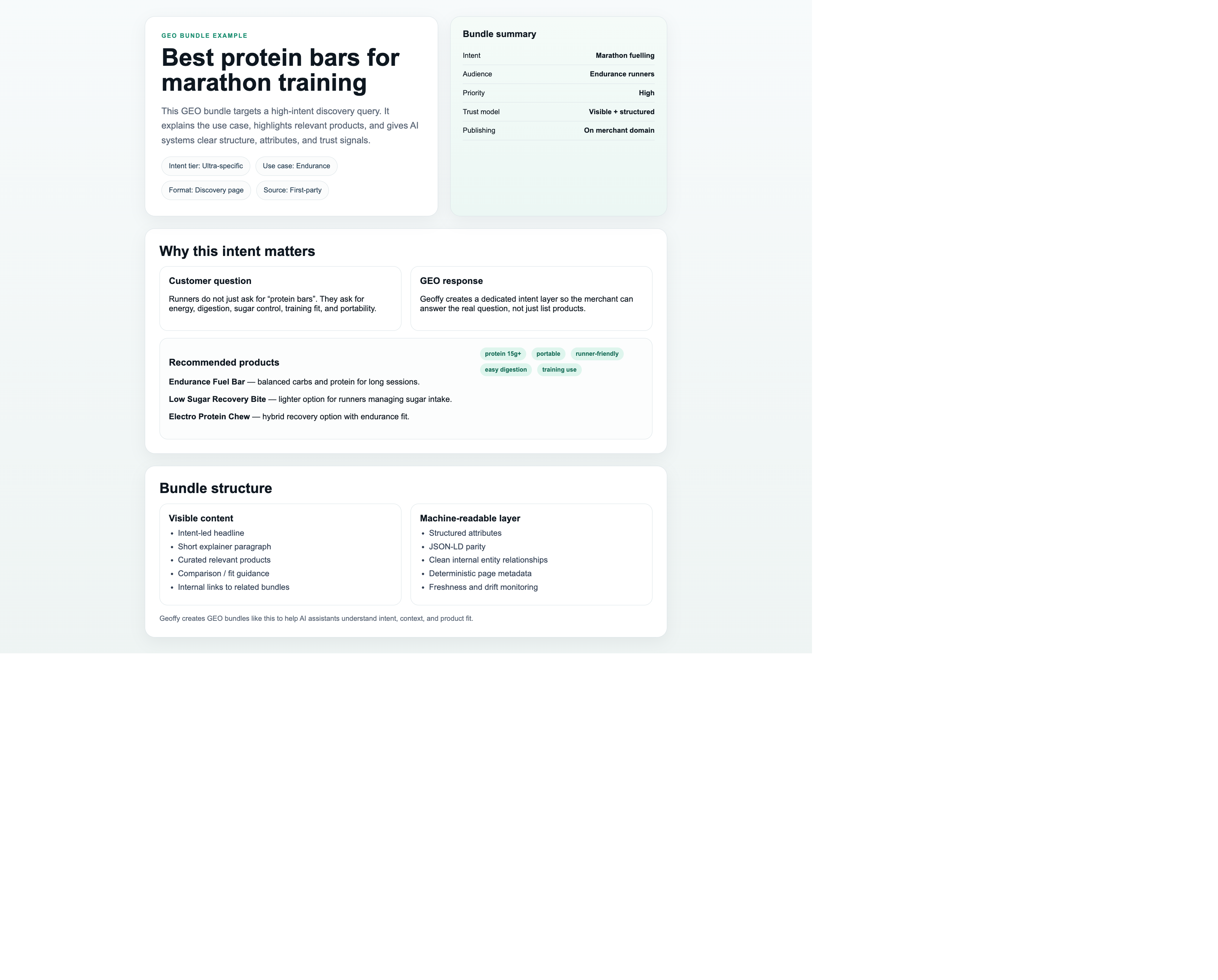
Cover all three on the pages you already publish — the product page carrying the depth for its own SKU, the category page doing the group-level version. They are blocks of content, not destinations of their own.
Resist the obvious shortcut of building a separate page per buying question. It splits the catalogue into two descriptions that drift apart the moment stock or pricing moves, and it shifts the content off the URL that already holds your links, reviews and purchase history — asking an engine to cite your weakest page instead of your strongest.
Capability 3: AI-readable content
AI-readable content is explicit and specific.
- include concrete attributes
- include use-case fit and constraints
- avoid vague promotional language as primary signal
Capability 4: Discovery infrastructure
Core infrastructure requirements:
- XML sitemap coverage for every product and category page
llms.txtat domain root- JSON-LD parity with visible content
- internal links between related product and category pages
- server-side render for AI-facing content
Capability 5: Attribution and measurement
AI influence is broader than direct referral clicks.
Track what is measurable now:
- custom GA4 channel groups for ChatGPT, Gemini, Claude, Perplexity, Copilot
- intent-specific landing pages
- crawler log patterns
Treat current metrics as directional while the channel matures.
Common mistakes to avoid
| Mistake | Why it fails | What to do instead |
|---|---|---|
| Treating GEO as standard SEO | AI systems are not ranking links the same way. | Focus on intent coverage and attribute completeness. |
| Relying only on ad feeds | Assistants often retrieve from web content and relationships. | Publish first-party content on your own product and category pages. |
| Skipping structured data parity | Mismatches reduce trust signals. | Enforce schema-to-visible-content parity. |
| Publishing hidden AI-only content | Creates trust and policy risk. | Keep transparent, visible-first outputs only. |
The brands that start now will be better positioned as AI discovery matures. If you’d like to explore what GEO infrastructure looks like for your catalogue, Geoffy is a good place to start.
Conclusion
The channel is still early, but the direction is clear.
Brands that build AI-readable product infrastructure now will have a structural advantage as recommendation systems mature.
About Geoffy
Geoffy helps ecommerce teams turn product catalogues into AI-readable discovery infrastructure, including intent-tiered pages and structured outputs with visible-content parity.
About the author
Anthony Gale is Co-Founder of Geoffy and has worked across ecommerce, digital growth, and product-led infrastructure for more than two decades.
Related reading
- The Anatomy of a GEO-Optimised Store — the practical companion to the five capabilities.
- The Ninety-Second AI Visibility Test — the “where do I start” answer.
- Shopify Picked agents.md. The Default Is Bland. — a Capability 4 update.
- What is Answer Engine Optimisation (AEO)? — the adjacent vocabulary.
References
- Adobe Analytics / Digital Commerce 360 — AI referral growth and quality data.
- Profound — LLM citation breadth benchmarks.
- Aggarwal et al. — GEO: Generative Engine Optimization (ACM KDD 2024).
- Cloudflare Radar 2025 — AI crawling activity trends.
- Conductor (2025) — AI referral share benchmarks.
- Enrich Labs (2026) — GEO adoption trend observations.
All data reflects public sources available as of March 2026 and should be interpreted as directional.