A strategic guide for agencies ready to build a GEO practice.
Updated July 2026. The client conversation has moved from “is this real?” to “how do we do it?”: 77% of US shoppers have used AI to shop in the past six months, and 44% start purchase journeys inside an assistant (Exploding Topics/Search Engine Land, April 2026). Meanwhile usage is fragmenting — ChatGPT’s share of generative AI traffic has fallen from roughly three-quarters to about half in a year (Similarweb) — which makes single-engine audits, still the norm among agencies, an incomplete service. Cross-engine coverage is now the credibility bar.
Executive Summary
AI product discovery is emerging as the next major ecommerce visibility channel. For agencies, it represents a significant service opportunity: clients need guidance, the expertise gap is wide, and the ongoing nature of AI discovery management makes it a natural retainer. This paper outlines why GEO belongs in the agency offer, what a credible GEO service looks like, and how to build a practice that compounds over time.
Section 1: Why this moment matters for agencies
The ecommerce agency landscape has been shaped by waves of channel emergence — organic search, paid search, paid social, influencer, CRO. Each wave created a window of opportunity for agencies that moved early to establish expertise, build case studies, and capture long-term client relationships before the channel became commoditised.
AI product discovery is in that early window now.
AI-referred retail traffic grew dramatically through 2024 and 2025. The channel is still small as a percentage of total ecommerce traffic, but it’s growing faster than any channel at the equivalent stage in its development. And the traffic quality is exceptional — higher conversion rates, longer sessions, and higher average order values than most channels agencies currently manage.
For agencies, the question is not whether to build a GEO practice, but how quickly.
Section 2: What clients need and why they can’t get it themselves
Ecommerce clients are aware of AI. Most have asked assistants product questions themselves. Many have noticed that their products don’t appear in AI recommendations. What they lack is a clear path forward.
The challenge is genuine. Building effective AI discovery infrastructure requires understanding how AI retrieval systems work, how to structure product data for machine reasoning, how to make the merchant’s existing product and category pages answer at every depth of intent, and how to keep all of it current as the catalogue changes. It’s not a simple content exercise.
Most in-house ecommerce teams don’t have the bandwidth, the expertise, or the tooling to build this well. That’s the agency opportunity.
Section 3: What a GEO service looks like
A credible agency GEO service has four components.
Discovery audit. Understanding the client’s current AI visibility position — which products are showing up in AI recommendations, which aren’t, and where the structural gaps are. This is a valuable standalone deliverable that creates urgency and defines the scope of work.
Discovery infrastructure build. Creating the first-party discovery layer on the client’s domain — structured pages organised around the real questions their customers ask AI assistants, covering the catalogue at the right level of depth and breadth.
Ongoing management. Keeping discovery infrastructure current as the catalogue evolves. This is where the retainer lives. Products change, new lines are added, stock status shifts — the page content and its structured data need to stay accurate and aligned.
Reporting and strategy. Tracking AI referral trends, coverage growth, and product-page performance. Translating directional data into strategic recommendations that demonstrate value and guide further investment.
Section 4: How to position GEO to clients
The framing that works is not technical. It’s competitive.
Your products are either showing up in AI recommendations or they’re not. Your competitors are either building AI discovery infrastructure or they’re not. The channel is growing. The early advantage is real. What are we doing about it?
That’s a conversation every ecommerce client is ready to have — and most don’t have an agency partner currently equipped to answer it.
Avoid leading with methodology or technology. Lead with the business outcome: recommendation visibility in a channel where the traffic quality is exceptional and the infrastructure advantage compounds over time.
Section 5: The tooling question
Agencies building a GEO practice face a build-versus-buy decision on tooling. Building proprietary infrastructure is possible but expensive, slow, and difficult to maintain across multiple client catalogues. The ongoing nature of drift management and catalogue sync alone represents a significant ongoing engineering overhead.
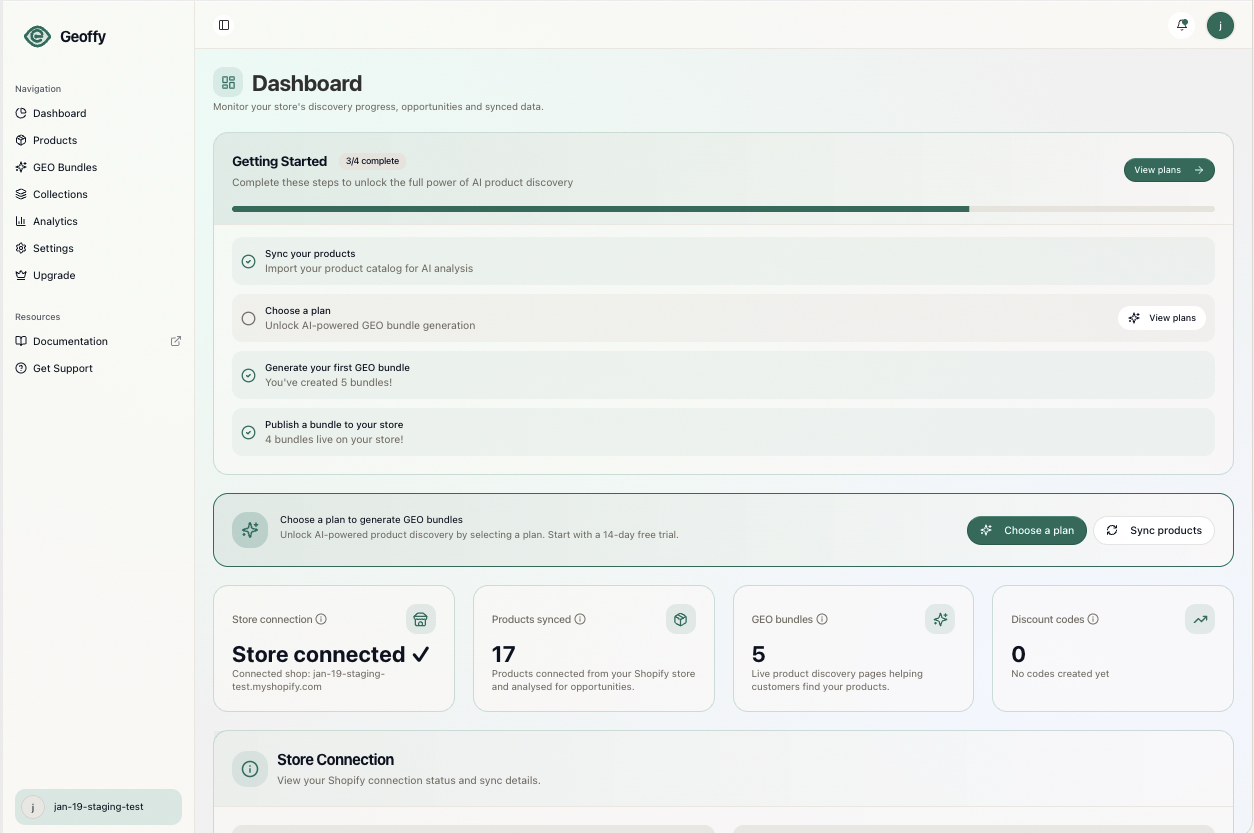
Geoffy is designed for agency use. Multi-client catalogue management, first-party publication on each client’s own domain, and structured reporting are built into the platform. Agencies use Geoffy as the infrastructure layer and focus their own value-add on strategy, audit, and client management.
Conclusion
The agencies that build GEO practices now will have a structural advantage in the ecommerce market for years. The window of differentiation is open. The client need is real. The channel is compounding.
The question for agency leaders is not whether GEO belongs in the offer. It’s whether to build the capability now, while the advantage is meaningful, or later, when it’s expected.
Talk to us about the Geoffy agency programme →
About Geoffy
Geoffy is a Generative Engine Optimisation platform that helps ecommerce brands and the agencies that serve them build first-party AI discovery infrastructure — structured, maintained, and built to compound over time.
Related reading
- How Agencies Can Offer GEO as a Service — the practitioner-facing version of this argument.
- How to Choose an AI-Visibility Tool — a neutral buyer’s guide to the tooling category.
- Optimising for ChatGPT Is Already the Wrong Goal — why single-engine auditing under-serves clients.
- Solutions for agencies — how Geoffy supports an agency practice.
References
Adobe Analytics / Digital Commerce 360 — AI referral growth and quality data (2025–2026). Aggarwal et al. — GEO: Generative Engine Optimization (ACM KDD 2024). Cloudflare Radar 2025 — AI crawling activity trends. All data reflects publicly available research as of March 2026 and should be treated as directional.