Updated July 2026. Two developments since publication sharpen this paper’s central claim. First, the discovery and transaction layers have visibly separated: Walmart publicly stepped back from checkout-inside-chat after conversion ran at roughly a third of its own site’s rate, refocusing on being present in the conversation while completing purchases in its own environment. Second, consumer data confirms the same split — most shoppers now use AI to decide, and almost none to buy in-channel (Exploding Topics/Search Engine Land, April 2026). The decision engine is here; the till has stayed put.
Introduction
Every decade or so, the way people find products changes.
The history of ecommerce discovery is, in many ways, a history of interfaces. Each era has been defined by the system sitting between consumer intent and the products they buy. Those systems have changed dramatically, but one pattern stays consistent: brands that adapt early build durable advantages.
We are now in the early stages of another transition. AI assistants are becoming a meaningful interface between consumers and commerce.
This paper examines how discovery evolved through three eras, what AI-mediated discovery means in practice, and what the medium-term future of ecommerce visibility looks like.
The three eras of ecommerce discovery
Discovery has moved through three distinct technological eras, each defined by a different mechanism for connecting consumer intent to products.
| Era | Period | Primary interface | Core model |
|---|---|---|---|
| Web directories | Pre-2000 | Human-curated category lists | Manual browsing to find products |
| Search engines | 2000–2023 | Keyword-driven search | Ranked links, user compares options |
| AI assistants | 2024–present | Conversational questions | Synthesised answers and shortlists |
As of early 2026, Google AI Overviews appear in an estimated 25% of searches. When present, organic click-through rates can fall sharply year-on-year. [2]
From search engine to decision engine
Search engines help users locate options. AI assistants increasingly act as decision engines.
In a search journey, users compare many links themselves. In an AI journey, comparison happens inside the model and users are shown a short list — a handful of products.
| Dimension | Search engine | AI assistant |
|---|---|---|
| User input | Short keyword query | Natural language question with context |
| System output | Ranked links | Synthesised answer with recommendations |
| Comparison work | Done by the user | Done by the AI system first |
| Products surfaced | Many options | Small shortlist |
| Optimisation target | Ranking position | Structured interpretability and attribute completeness |
The strategic implication is straightforward: the competitive surface is now narrower, and missing the shortlist can mean being excluded from consideration entirely.
How AI systems evaluate products
Large language models do not rank pages the way traditional search engines do. They reason over product information.
When users ask product questions, AI systems evaluate:
- attribute match
- use case fit
- comparative positioning
- trust and consistency
- recency and availability
This is why parity matters. Structured data that contradicts visible content is a trust failure.
Looking ahead: AI-native commerce
The current phase is likely transitional. Several trends point toward AI-native commerce:
- conversational shopping as a first-class journey
- multi-turn recommendation sessions
- agentic purchasing behaviours
- stronger platform-level integrations and feed pathways
OpenAI Operator and Anthropic Computer Use are early demonstrations of agentic workflows in which a machine navigates and evaluates the buying journey on a user’s behalf. [5]
For merchants, this raises the bar for machine-readable product quality.
Strategic implications for ecommerce brands
AI discovery does not replace SEO, but it changes what visibility means.
| Strategic question | Search-era answer | AI discovery-era answer |
|---|---|---|
| How do I get found? | Rank for keywords on page one | Ensure complete, crawlable, structured product meaning |
| How do I cover intent? | Target keyword variants | Answer Broad/Mid/Ultra intent on the product page |
| How do I measure progress? | Rankings, impressions, CTR | AI referral trends plus directional visibility testing |
| Long-term moat | Links and domain authority | Attribute depth, intent breadth, semantic consistency |
AI referral traffic is still small in absolute share, but quality signals are strong: higher conversion rates, longer sessions, and higher revenue per visit in cited retail datasets. [1]
Conclusion
The future of discovery is conversational.
The core question is no longer only “Can users find my pages?” but “Can AI systems understand and recommend my products?”
Generative Engine Optimisation is the infrastructure response to that shift.
About Geoffy
Geoffy is a Generative Engine Optimisation platform that helps ecommerce brands on Shopify and WordPress make product catalogues legible to AI assistants and AI search systems.
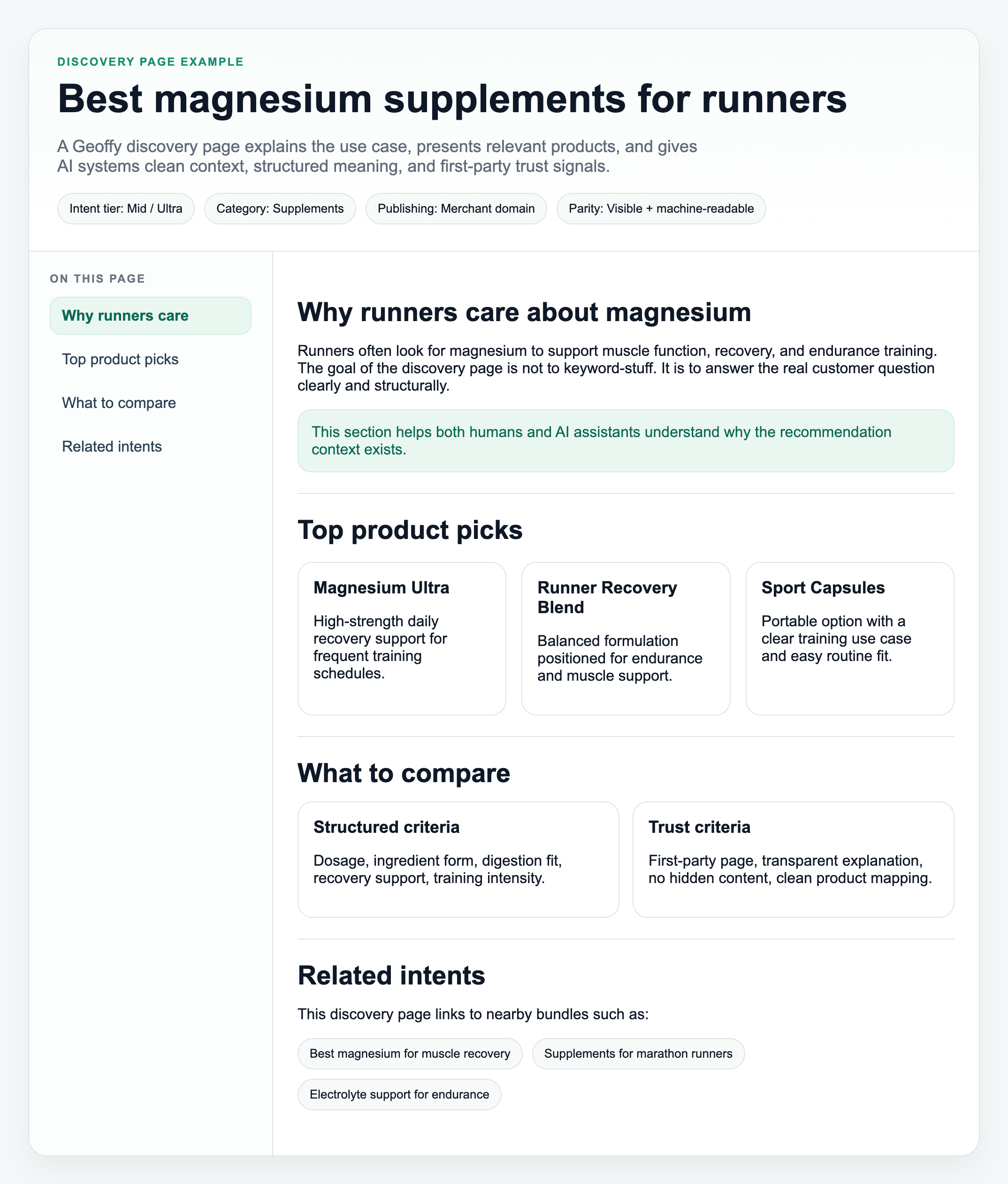
Geoffy generates intent-tiered content and structured JSON-LD, published onto the merchant’s own canonical product pages.
About the author
Anthony Gale is Co-Founder of Geoffy and has spent more than two decades working in ecommerce, digital growth, and product development.
Related reading
- AI Is a Discovery Channel, Not a Checkout Channel — the consumer data behind the split.
- AI Found the Product. Walmart Took the Cart Back. — what happened when a retailer tested checkout-in-chat at scale.
- What is Answer Engine Optimisation (AEO)? — the adjacent vocabulary.
- What is Generative Engine Optimisation (GEO)? — the foundational explainer.
References
- Adobe Analytics / Digital Commerce 360 — AI referral growth and quality metrics (2025–2026).
- Conductor / Pew Research (2025) — AI Overviews prevalence and CTR impact.
- Profound — Typical LLM citation breadth (domains cited per response).
- Aggarwal et al. (Princeton / Georgia Tech / IIT Delhi) — GEO: Generative Engine Optimization (ACM KDD 2024).
- Industry coverage of OpenAI Operator and Anthropic Computer Use (2025).
All data reflects publicly available research as of March 2026 and should be treated as directional.